Whilst staying near Bakewell, I had a call from one of my oldest and dearest friends. She lives in Sheffield and was planning to visit Chatsworth with a friend, on the Friday. As we had planned to visit on the same day, we were able to combine a lovely day out with a reunion.
The weather was supposed to be reasonable on that day but we packed our waterproofs in our backpacks just in case. Lucky we did as it turned out! Fortunately we were able to provide lunch and hot drinks in the van whilst we awaited an improvement. But, I am ahead of myself…
We drove throughout Chatsworth village, past the farm shop and through the pretty parkland. The house was ahead of us and made an impressive sight.
Imposing view from the car park
It is not cheap to get in to Chatsworth but, I had booked online and saved £4. There are no concessions and no annual pass conversion as with Blenheim Palace. However, we made the most of our day and were amongst the last stragglers to leave!
Chatsworth is the seat of the Duke of Devonshire and has been home to the Cavendish family since 1549. The current Duke and Duchess are very much involved with the estate and indeed, if you have reason to phone, it is the Dukes voicemail message on the answer phone! I discovered that when the lady in the tourist information office made a call on my behalf to ask about the e.ticket.
The house contains works of art dating back 4000 years and also has more modern prices by Lucien Freud, Edmund de Waal and David Nash. Add to that the sheer scale of the place and the opulence and it is really impressive. There are interesting quotes from people, such as builders and decorators, who have worked on the house over the years, displayed on the windows. One of the most impressive features is the 24.5 carat gold on the window frames in the courtyard. The preparation and execution is described in great detail by those who worked on it. Absolutely fascinating.
Inner courtyard. The window frames are coated with 24.5 carrat gold!
I was particularly impressed by this sculpture. It looks as though you could wrap the veil around the figure, it was so finely executed.
Seriously impressive statueDescription of above statue
The many rooms are elaborately decorated, as one would expect in such a grand house.
Ceiling art!LibraryFabulous interiors is a common thread hereMore ceiling art!Entrance hallThis is a shower from 1800s
Before the rain fell upon us in a deluge, we managed to enjoy the maze, the rockery and the long walk. The gardens were first constructed in 1555 by Sir William Cavendish and Bess of Hardwick. Capability Brown had an input in 1758 but there have been othercontributors over the years. Today you can see the 300 year old Cascade, the Willow Tree Fountain and the gravity fed Emperor Fountain. There is also a maze, rockery and rose, cottage and kitchen gardens to enjoy. Unfortunately the heavy rain curtailed our garden exploration.
Water feature. Only runs for short periods to save waterGarden stepsRock garden
We only scratched the surface of this magnificent stately home. It would be worth another visit next time we are in the area.
We are working our way towards Scotland but had an appointment near Preston to get a TV fitted.
Yes, we have decided, after a year of travelling, to have the option of watching dvds. We found the evenings long and dark last winter, even in Spain. Much as we love reading, crosswords, crochet etc, sometimes we really craved a bit of entertainment.
On the way north we spent some time in parts of the Peaks not previously visited. Here is a selection of views we enjoyed in spite of the fading weather. We stayed on farm campsites in some stunning locations near Bakewell, Castleton and Holmfirth. The roads were often narrow and twisty and went up and down a lot! You don’t get great views without some effort!
View towards Bakewell from riverside walkBakewell bridgeWalk up to Surprise ViewDark Peak Surprise View
High up at Surprise ViewBoulder view!Digley Reservoir near HolmfirthAnother Peaks roadStormy campsite! Whitegate Leisure Camping, near Holmfirth
We booked a hill top campsite close to Holmfirth for 2 nights and were advised by the owner, not to follow the sat nav, but to follow his complicated directions from the town centre. Needless to say, by the time we were actually making the trip, I had slightly forgotten the fine details and I was unable to find the correct road. Using a mixture of map and sat nav, I navigated us up a very narrow road with the sharpest hairpin bend we have ever encountered. How my trusty pilot got us round it, we will never know. Not an experience to be repeated! When we arrived, the owner pointed out the correct road and tsk tsked at my tale of woe.
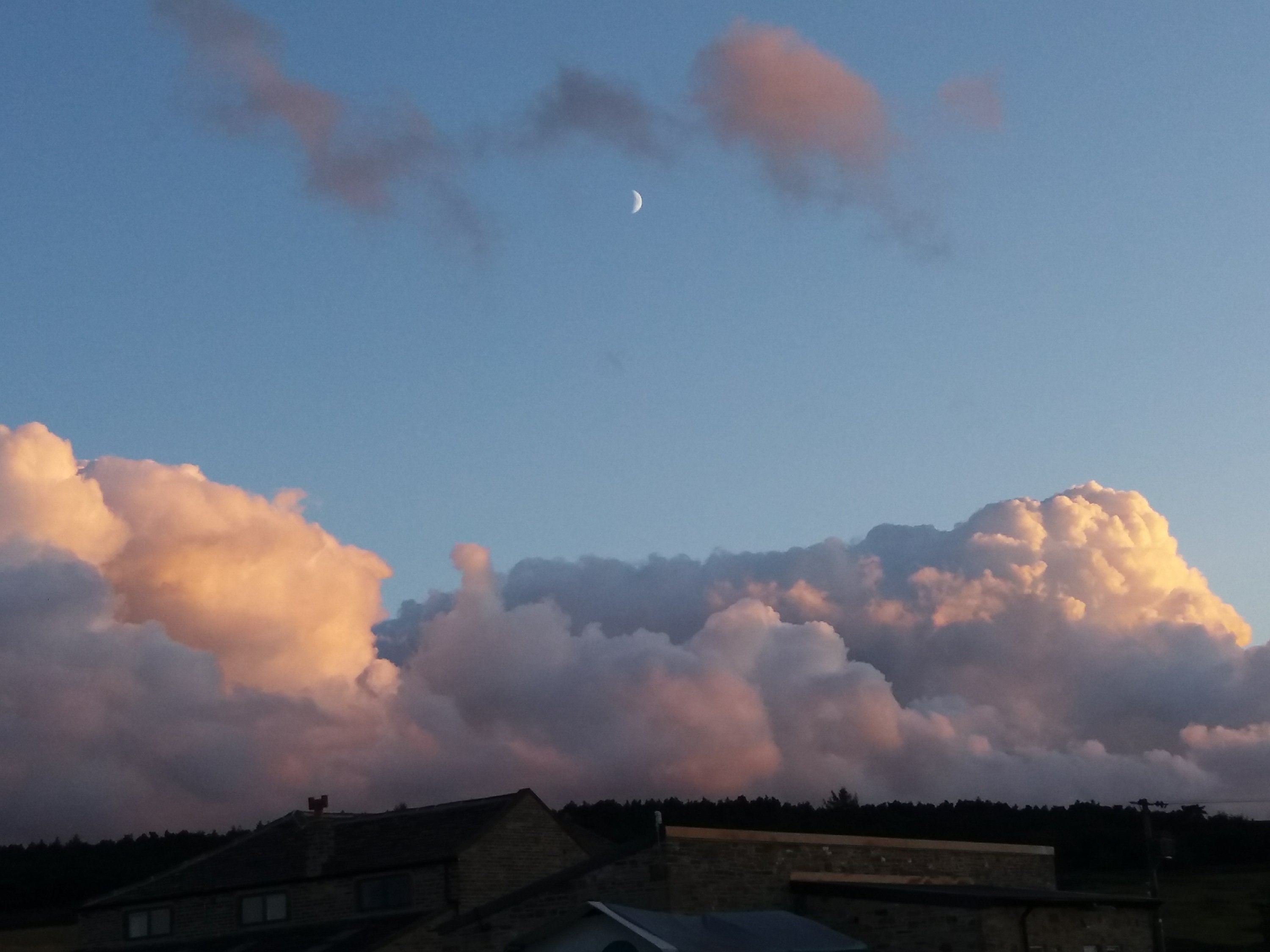
Driving down Winnats pass to Castleton from Rowter Farm campsiteHeading down to CastletonTrees at side of reservoirDramatic stormy view of the peaksSunset clouds over the Peaks
Whilst we were staying near Bakewell, we invested a great many Great British Pounds in a visit to Chatsworth. See separate post.
After a fabulous couple of weeks in the Peaks, we travelled north to Lancaster for a quick visit before our appointment in Bamber Bridge near Preston.
We returned home in time to prepare for Marcus’s wedding on 22 Jul. The weather remained glorious and their wedding garden party was a wonderful family occasion.
To recover, and as we had an appointment in Banbury on 25th, we left the family once more. Appointment over, we had a quick look at the map and saw that we were close to Blenheim Palace. As we have not been there, we booked onto a budget pitch at the Caravan and Motor home Club site at Woodstock for a few days. A shady pitch under the trees was very welcome as it was still very hot.
Our first day was spent relaxing and taking a leisurely stroll into Woodstock. It is a delightful Cotswold town with little shops and hostelries.
One of the attractive roads in the centre of WoodstockWoodstock town hall
We had a pleasant walk around then stocked up in the Co-op. Clyde had a lot of discomfort with his leg and the heat didn’t help, so we decided to drive to the Palace next day.
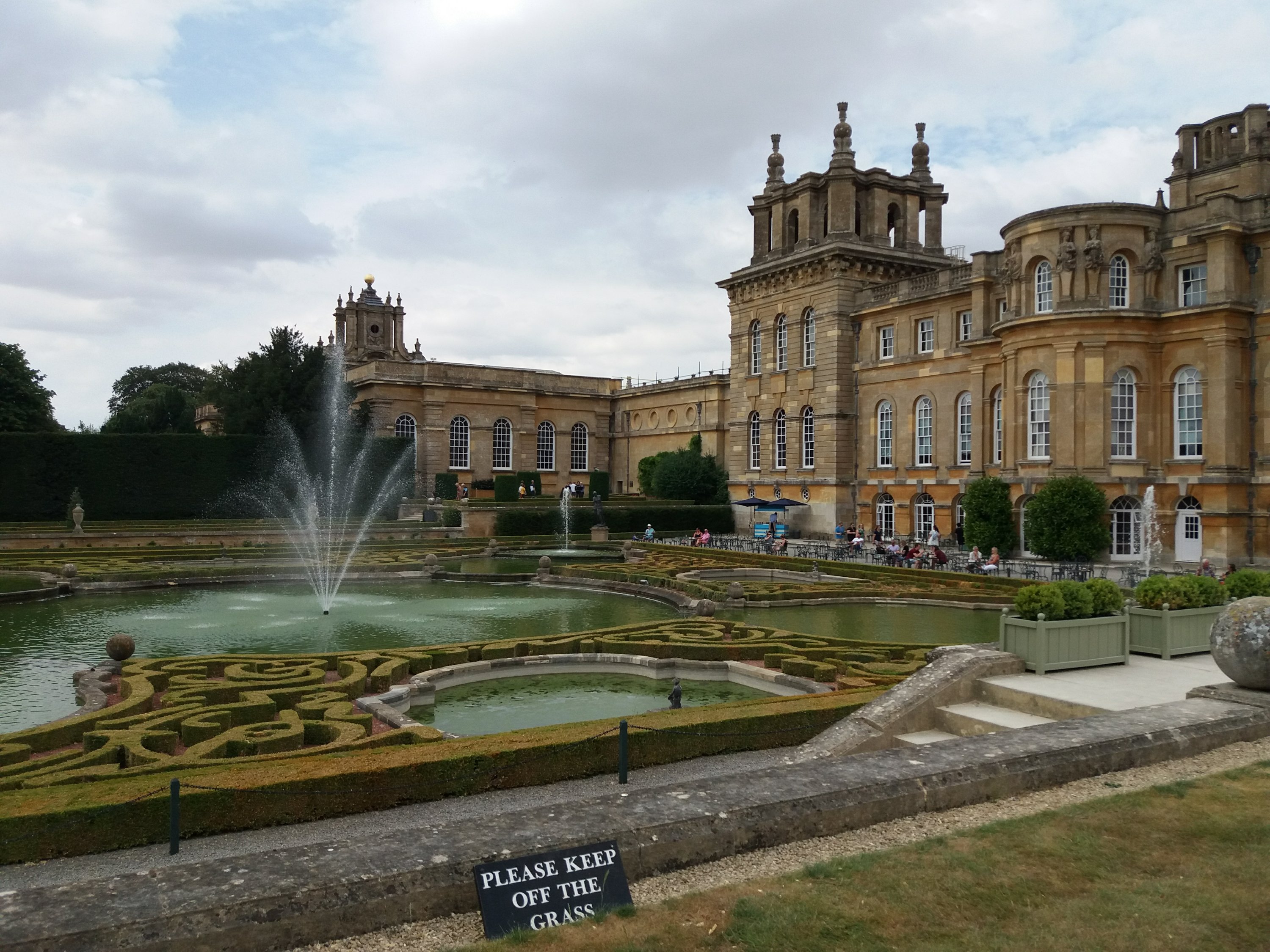
Having been to Chambord recently, we were interested to see how our English country pile would compare. Of course, it is completely different and has a history that we can identify with. This is very much more of a home and the human touches are everywhere. This was the birth place of Winston Churchill and therefore, very much more interesting to us. There is a very interesting Churchill exhibition which should not be missed.
Front door and Palace courtyard
The rooms that were open to the public were all ornate with fabulous ceilings and immense wall hanging tapestries. The tapestries have been restored in Belgium and should now last for many more generations to enjoy.
One of the many fabulous tapestries and ornate roomsEnormous library with organOrgan at the end of the libraryImpressive sculpture in the chapel
As the day was so hot, we decided to explore the house and, as we had converted our ticket to an annual pass for free, we planned to explore the grounds next day. We did have coffee at the terrace cafe which overlooks the splendid terrace garden.
Terrace garden with multiple fountainsView of terrace garden from the sidePalace from the walk to the formal gardens
Believe it or not, when we returned the next day, it rained heavily! After waiting for it to pass over whilst drinking more coffee, we gave up and decided to come again within the next 12 months.
With huge wisdom and an unerring sense of direction and distance, I decided that we could visit Honfleur en route from Chambord to Dieppe!! I later discovered that I had remembered the ferry time wrong by 3 hours but, at this point it was not on my radar.
It was quite a long way from the Loire and the extremely high temperature made us grateful for the cab air con as we navigated our way north avoiding the toll roads.
We had decided to stay on a campsite 3 km outside Honfleur and take the bus into the centre. We were also able to get a load of washing done and have a refreshing shower. The site was very convenient for the bus stop and they provided us with a timetable and a tourist information leaflet. Next day we sallied forth and spent a massive 50c each on the bus fare!
Honfleur nestles between the Seine estuary and the plateau of the Pays d’Auge. It is still a fishing port and now has a popular yacht harbour. The town has a rich historic and artistic heritage with picturesque streets and traditional buildings. There are numerous art galleries and antique shops to enjoy.
Shopping streetCobbled square
The harbour area was busy and colourful and there were full tables at all the restaurants that lined the surrounding streets.
Colourful harbourside buildingsFishing boats and yachts
We also found the 16th century church of St Catherine a welcome change from the usual gothic architecture. It is a wooden structure which was built by shipwrights and is the largest wooden church with a separate bell-tower, in France.
St Catherines churchInside the churchChurch organWooden bell tower
There are plenty of interesting buildings and the sea front and park are popular with families. There is also a beautiful merry go round at the end of the old port (vieux bassin).
One of the beautiful old buildings alongside the Vieux Bassin
After a very hot few hours roaming around Honfleur, and a delicious ice cream to cool us down, we caught the bus back to the campsite. It would definitely be worth another visit one day as we only scratched the surface.
Back at the van I checked the itinerary for our ferry home to discover – it sailed at 1230, not 1530 – oops! We thus had a very early start to our day on 2 Jul but it was a pretty 2 hour drive to Dieppe and we arrived in plenty of time.
After Annecy we had to start making our way back towards Dieppe. We had time to visit some of the places in the Val-de-Loire that we missed on the way down due to the poor weather. We could not stop in all the places that appealed to us, so we drove the scenic route D952 starting at Gien. The road took us through some rather less hilly countryside than we had experienced during the last few weeks, but was pleasant and had tempting glimpses of the Loire and pretty villages. By the time we had meandered as far as Chateauneuf-Sur-Loire, we were ready to stop for the night. We quickly checked the ACSI book and found a cheap site that was right on the banks of the Loire. It was so well placed for enjoying the river and the little town, that we stayed for 3 nights.
Loire-side campsite
Chateauneuf-Sur-Loire
This is a quaint little town which had a castle until the French Revolution. The building was largely destroyed after that time, but the rotunda still survives and now houses the town hall.
Council offices in the rotundaBug houses in the gardens
You can view the decorative entrance hall but not on the day we were there! Around the castle are the landscaped gardens which cover several hectares with remarkable tree specimens and alleys of magnolias and giant rhododendrons. The views across the Loire valley from the castle gardens are most attractive.
Loire valley view from the old chateau
The church of Saint Martial in the centre of the town, has a very unusual entrance and beautiful stained glass windows.
Exterior of Saint Martial churchColourful window in the church
Saint Dye-Sur-Loire
My aim was to visit the Chateau du Chambord and the aire at Saint Dye was the closest spot to stay. It is possible to stay overnight in the chateau car park but, it costs €17 and is not such an attractive location.
We parked for free alongside the Loire and enjoyed a walk along the river to the village church and centre. The patisserie was rather enjoyable too!
Our view from the free aireSunset over the riverManor House overlooking the Loire on edge of the villageChurch road!
Chateau Chambord
We had a very short journey to the chateau and parked for the princely sum of €11! The walk to the chateau along a footpath gave an enticing view through the trees to the chateau.
First glimpse of Chambord
As we got closer and had a clearer view, it was seriously impressive.
Chateau Chambord in all its gloryView from the approach footpath
We enjoyed our visit and paid extra to have the histopad which gave visual information and an English commentary.
One of many richly decorated rooms
Although there were 24 rooms to visit, some of which contained historic artefacts, the outside was more interesting architecturally.
One of the terrace viewsAnother impressive tower
Having said that, the chateau is known for its double-helix staircase which is attributed to Leonardo da Vinci. There are two separate flights of stairs proceeding upwards around a hollow newel post. If two people choose to use different flights, they will catch glimpses of each other through numerous loopholes as they ascend…without ever meeting!
Double helix staircase
Alongside the staircase there are vaulted rooms with amazing ceilings. The oratory on the first floor is similarly decorative.
Oratory
Outside the chateau there are extensive grounds to be explored (13450 acres)
Extensive grounds stretching away from the chateau
and the Chambord Chapel of St Louis, which was built before the chateau.
Inside the chapel
The formal French gardens are best viewed from the terraces at the top of the chateau. They were completed during the reign of Louis XV and existed for 2 centuries before falling into disrepair. They were restored in 2017 and have still to reach maturity but are nonetheless attractive in design.
French Gardens
I was not disappointed with the chateau and together with the drive along the Loire valley and the riverside camping opportunities, it was a fabulous few days.
After Castellane we needed to start working our way back northwards. I had read really good things about Annecy, so we decided to go there but had to break the journey up. The next stop we identified was at Gap and we decided to stay on a campsite and use their electricity to charge all our equipment. The ACSI site we stayed on was very quiet, apart from the noisy peacocks that were roaming about! We also managed to fill up with LPG ready for further off grid stopovers and cooking. The weather was gorgeous, so we had an extra day just soaking up the sun. We did not go into Gap itself.
Moving on from Gap took us through amazing scenery just as stunning as the journey from Castellane to Gap. By now we were starting to get view overload!
Distant mountains en route to AnnecySound of Music?!!
Le Bourget du Lac
As we wandered towards Annecy we came upon another lovely lake and stopped there for a couple of days. We stopped on an aire that was outside the gates of a lakeside campsite. The advantage was that we could use their facilities. It was a short walk to the lake in one direction and to the village in the other. The lake was very popular and had a beach with facilities for swimmers and there were also boaters and kite surfers on the main lake. As the sun was shining brightly, it was a very busy place.
Lac du BourgetOff shoot alongside the campsiteKite surfer with mountain backdropAnother lake view
Annecy
We drove through Annecy on our way to the campsite. As we rounded a bend and saw the bright turquoise of the lake, we really thought we must have overshot and arrived in Switzerland. Somehow, we had not expected it to be so beautiful. After a couple of disappointments, we arrived at a lovely family run campsite, just a stones throw from the lake and a 15 minute walk from a bus stop. The site was in Sevrier, just 7 kms from Annecy town.
Campsite view. Nature reserve and mountains!
The next day we caught the bus and armed with the tourist trail map from the campsite reception, we made sure we saw all that interested us.
Annecy can date itself to the Neolithic period as there have been significant remains of lakeside villages uncovered that testify to human occupation from that time. From then on there have been many changes that have ensured it remained an important settlement. In the 21st century, Annecy presents itself, in the magnificent setting of its mountains, its lake and its old quarters, as a multi-faceted town which captivates its visitors. It is also undergoing strong population and economic growth whilst maintaining its tourist appeal. It captivated us and the thousands of other tourists that were clogging up the streets!
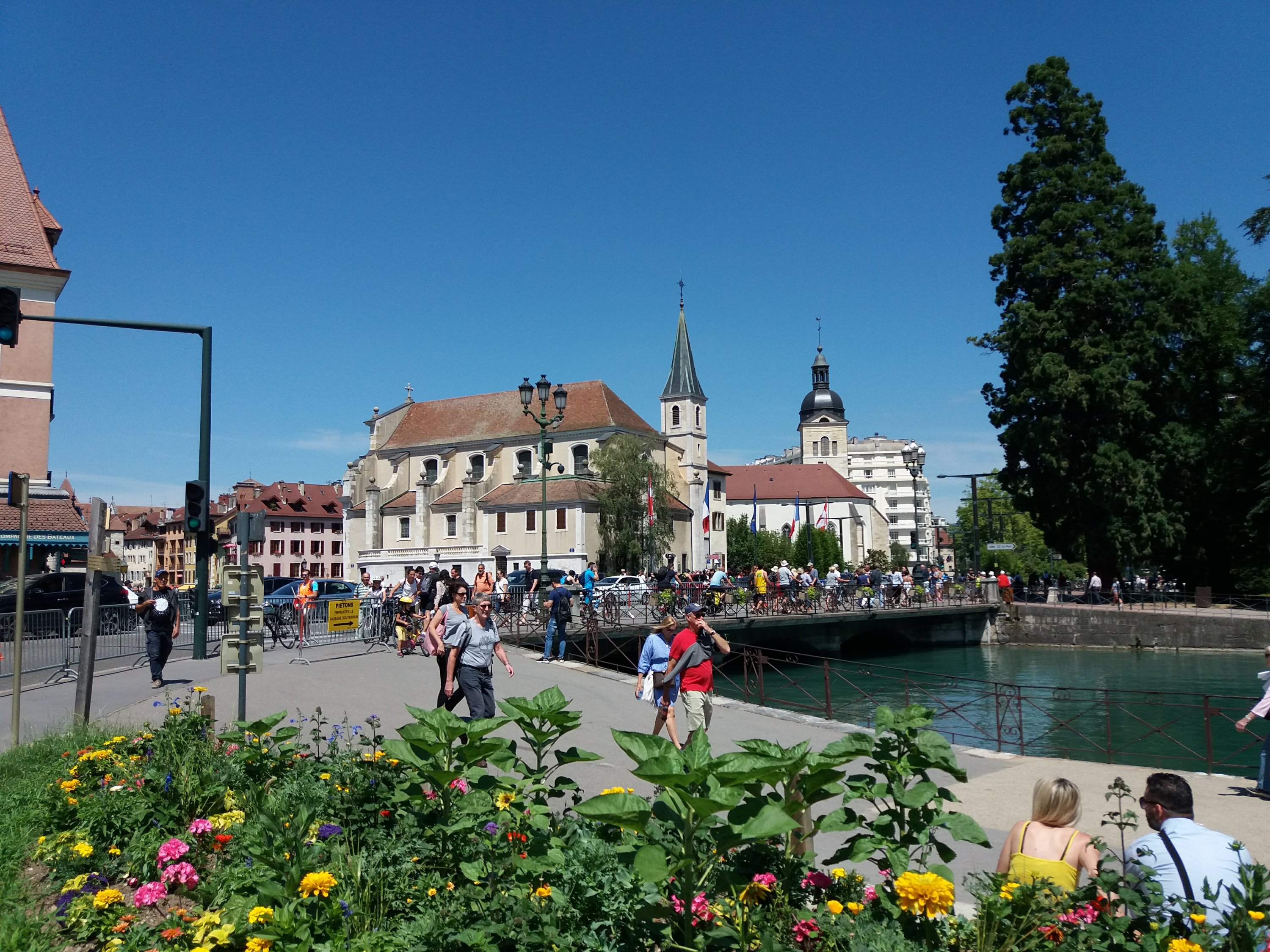
The first day we concentrated on the lake and the canals which also took us through the old town streets. We had lunch sitting in one of the main streets and enjoyed the lively atmosphere. The walk around the park side of the lake was beautiful with that bright turquoise water glinting in the sunlight. There was plenty of people watching to satisfy me. We also managed to visit a couple of churches along the way and Palais De L’ile.
Lakeside viewView from the Pont des AmoursBusy promenadeAmazing sculpture on the lakesideShopping streetInside the St Pierre cathedralOne of many vaulted shopping streetsLooking towards the old townThe historic Hotel de Ville. The 1771 ironwork of the staircase displays the trout of the coat of arms of AnnecyPalais de L’isleCanal running along and around the Palais
The next day we went back to visit the chateau. The journey in took a lot longer as there was a triathlon taking place and the police were holding up the traffic as the cyclists flowed through. The bus driver let us all get off near to the town as it was quicker to walk the rest of the way. The chateau overlooks the town and the lake and houses some interesting exhibitions. The best part was the views over the town.
Castle courtyardTown view from the chateauView from the chateau to the lake
This is another area of France that was new to us and that we would gladly visit again. It would be worth spending more time here and, if we can source a bike for Clyde that he can ride with his unbending leg, we can explore some of the many bike trails.
This is another of the most beautiful villages but, we had chosen to stay here as it is ideally placed for a visit to St Croix du Verdon and is also at the start of the scenic route along the Gorges du Verdon to Castellane.
Moustieres sits at the entrance to the Grand Canyon du Verdon, protected by a golden star suspended on a chain high above the village between two rocky cliffs. Try as I might, I could not manage to photograph the star.
Medieval Moustieres was a village of stationers, potters and drapers due to the body of water that still flows down the rocky cliffs. In the 17th century an Italian monk from Faenza brought the secret of enamelling here, and Moustieres became the capital of the most beautiful faience. That industry disappeared in the 19th century but has now been revived and over a dozen studios marry tradition with innovation. We looked around some of the studios and were very attracted to their beautiful products. We were less attracted by the prices!
Walking up through the villageVillage wash houseDistant view from the steps up to the chapel
The village was bustling with visitors when we were there and we enjoyed sampling the local pastries, whilst sitting on a bench overlooking the valley. Once fortified we made the 350 steps climb up to the chapel of Notre-Dame-de-Beauvoir. The views down over the village and the valley beyond towards the Lac de St Croix made the climb worthwhile.
Village viewOut across the valley belowLooking up to the chapelFront door of the chapelThe church in the town centre. Visible from all around
The journey back down on the uneven stones was a bit more challenging and especially so for Clyde with his dodgy knee.
St Croix du Verdon
This small village overlooks the Lac de St Croix and is best seen from the twisty road down from the hills behind. It was an interesting drive along the mountainous road to the village which is set on the side of a steep rocky outcrop.
Looking down over the village
We parked at the aire, which overlooks the lake and is a fabulous spot for an overnight stop. It is a short walk into the village and there is a restaurant with a large terrace overlooking the lake. There were plenty of patrons there enjoying lunch as we wandered past. Down on the lake, we could see plenty of activity involving children and sailing dinghys. Altogether, a very pleasant spot to while away a few hours.
View from the aireSome villagers have an amazing view from their garden!
We have a book called the Official Guide to the Most Beautiful Villages of France. As we are travelling through the various regions, we are checking for any of the villages that are close by.
After visiting Apt for the Saturday market, we backtracked a bit to visit two of the villages in the guide, Roussillon and Gordes.
Roussillon
Roussillon is also known as the flame of the Luberon. It stands out amongst its verdant setting with a variety of ochre shades lighting up the hills around the area.
Looking across to Roussillon village
The village’s rise in fortunes from 14th century was due to silk farming and the ochre industry took over in the late 18th century. It was developed due to a local man, Jean-Etienne Astier, who devised the idea of extracting the pigment from the sands. Since then Roussillon has built it’s reputation on this brightly coloured mineral.
We followed the ochre trail that winds through the former quarries and were bowled over by the contrasts of shape and colour against the variety of trees and plants.
On the ochre trailCombination of rocks and vegetationStartling brightnessSo many trees as wellUnusual sun dial
The village as also an attractive place to spend some time. It is certainly a tourist attraction but, on our visit, it was relatively quiet. The broad palette of ochre shades is evident on the buildings and there are several shops specialising in the artists materials and products connected with the ochre trade.
Centre of the villageColourful house frontsOlive press
Gordes
Gordes is described in our guide, as the Jewell of the Luberon. It is a short journey from Roussillon, so we made it our next stop. There is an aire just below the town which was extremely convenient for our visit. We arrived mid afternoon and having parked up on the aire, we walked back along the road to have a proper look at the view of the town. It had wowed us on our drive up to the town and there were several visitors on the roadside taking pictures. The Rough Guide had advised that the best part of Gordes is the view from the road and we would agree.
View of Gordes from the roadAnother roadside view
We went back in the evening to see the town lit up but, there are so many street lights, it was not as impressive as we had hoped. The buildings alongside the road were illuminated which helped us to see where we were going and they looked very attractive in the dark.
After a peaceful night in the almost deserted car park (aire with no facilities at all), we went into the town to explore and we were a bit disappointed after the splendour of the view on the approach. The town is perched on the foothills of the Monts de Vaucluse, facing the Luberon mountain. The views out from the narrow streets of the village are spectacular and there are some wonderful residences with fabulous views from their terraces.
View across towards RoussillonView out from the villageAnother view out
The chateau takes a dominant position but can only be visited by arrangement so we did not get to see inside.
Chateau
We enjoyed our visit to Gordes mainly for the views of the town itself and for the sweeping views across the surrounding countryside.
The Luberon
This area of France is beautiful for the variety of landscape. We were delighted with the views as we travelled around and particularly enchanted by the fields of lavender bordered by great swathes of poppies.
This area is also known as the Grand Canyon of Verdon. It is one of the deepest gorges in Europe. It was formed by the erosion of the limestone plateaus of Haute Provence by the Verdon river. There are two routes along the gorge, the north route D952 is the less terrifying, so we plumped for that one. The route along the southern side on the D71 is known as the Corniche Sublime and is generally considered to be more challenging. We would have tackled it in a car but, not so keen in the camper.
The journey along this road was full of WOW! moments and we stopped when possible to drink in the splendour of the views. We had lunch overlooking a very picturesque stretch with rapids that was providing an exciting experience for groups of kayakers.
Tackling the rapidsPopular spot along the gorge
We stopped for a while at the village of La-Palud sur Verdon
Church at St PaludThe Mairie’s place
and again at Point Sublime
Bit of informationView from the Point de Sublime
where you can watch eagles and vultures flying high above the mountains. There were also some slightly heart stopping moments along this road as the rocks hang out over the road and there are some sheer drops to the gorge below.
Rocky bit!Gorge viewMore scenic views
However, we made it in one exhilarated piece to Castellane where we parked up for a couple of nights next to the river Verdon.
The scenery we enjoyed has been a huge bonus in our trip to this area of France. We had no idea what to expect and we have not been disappointed. We are constantly amazed by the beauty of the countryside and the drama of the hills and mountains all around us.
We spent 2 nights at this rather lovely little town where the river Verdon flows energetically past the town centre. Our parking space on the aire was by the banks of the river and we enjoyed watching groups tackling the rapidly moving water in their kayaks. It was a very short walk up a narrow street, complete with boulangerie, to the town square.
Town square
We enjoyed exploring this charming little town and I decided to exert myself once more and climb up to the Chapelle Notre-Dame du Roc. The Notre-Dame du Roc dominates Castellane and its surroundings as it has done since the beginning of the 13th century. The pathway takes you along the remparts, past the ruins of Petra Castellana, past the stations of the cross along the way, and on up to the highest point overlooking the town and gorge at 911 metres.
Distant view of the RocView of the town from part way up the footpath
The statue on the chapel can be seen from the town below and it looks very small from the ground! It took me an hour to get to the top and a bit less to get back down. The path is very uneven and stony and it was rather hot but, I really enjoyed the stunning views along the way.
Looking down to the town and riverClose up view of the ChapelleLooking at the chapelle from the highest pointIt really was this high!Inside the chapelle
I staggered back to the van to find Clyde relaxing and enjoying the antics of the youngsters in kayaks.
We met two couples travelling for 3 months together around Europe. They were a German couple and their American friends who had met in Alaska whilst travelling there. The Germans were determined to show their friends as many places as possible in the 3 months. The American lady said she was exhausted with the early starts and constant travelling. However, they were having a great time. We enjoyed their company for a few hours and next day they were up and away early!
Yesterday we decided we would move on to a small town called Apt. It had a decent review in the Rough Guide to France and it was especially recommended to visit on a Saturday for the vibrant market. We were convinced that we were making this decision on a Thursday and therefore we were moving on Friday to be in situ for an early walk to the market on Saturday. Yikes!! It turned out to be Friday already. Retirement huh!
So, after a quick revision we decided on an early departure from St Remy on Saturday morning. It would have been earlier if I had remembered to check whether the campsite accepted card payments. I did not have enough cash, so we had to make a slightly tricky visit to the town in the van for a cash dispenser. Another lesson learnt!
We arrived at the Municipal campsite in Apt and quickly parked ourselves. It is very handy for the town, just a short stroll over the bridge. The market was in full swing and we made sure we didn’t miss anything. We bought a few essentials and after a quick exploration, returned to the van for a very late lunch.
Market in Apt
On Sunday we went back for a look around the town without the hustle and bustle. The atmosphere was quite different. There are many small streets with a real mixture of well kept, attractive buildings alongside run down, slightly derelict properties. It seemed rather gloomy today although in the main squares there were eateries open and people sitting out enjoying the sun. The public buildings were splendid as seems to be usual in most towns. There was a nice little park with a strange fountain and the main street bedecked with flowers.
One of the finer buildingsOne of several attractively decorated bridges
It is a place of contrasts and quite pleasant for a short stay. The municipal campsite was a bit quirky but cheap, and we rather enjoyed it.
On the Monday we went for a drive along the D900 into the hills and had our lunch overlooking verdant fields and woodland. We did not realise we would be driving along this road again on the next leg of our travels……
One of the most beautiful villages in France is Les Baux de Provence. We had a quick visit as the weather was awful and we could not see the wonderful views for which it is renowned. For that reason we did not pay to go in the chateau. Here is a small taster.
View from the approach roadView from the street leading to the chateauView down to the Baux valleyPopular view pointInside the Penitents ChapelView from road to the chateauApproach to the village close to the chateau
After the wild splendour of the Camargue, we back tracked a bit to visit St Rémy de Provence. This is a small town with a well preserved historic heart. On our first day we explored the town, ambling up and down the narrow streets and enjoying the atmosphere. It is obviously a tourist destination and was full of American and Japanese groups enjoying the history and the shops selling local goods.
Town Hall squareAnother square to enjoyOne of many shopping streets
We found the tourist information office and were given a map with two walking trails. The historic trail around the old town was useful and we used that to ensure we didn’t miss anything vital. The Van Gogh trail we saved for the next day.
The narrow streets worked their usual magic on us. There are a number of statues built into the corners of buildings which we found interesting and we had been unaware that this was the birthplace of Nostradamus. He was born in 1503 and spent his youth here before he became a famous doctor and astrologer. There is a fountain dedicated to him and it is possible to view a vestige of the house in which he is born.
Corner StatueNostradamus fountain
The Church of Saint Martin is a rather miserable place but, it does have a magnificent organ which was worth visiting for.
Magnificent organ in St Martins church
Following the Van Gogh trail up to the Monastére Saint Paul de Mausole, was informative, as there are panels along the route displaying reproductions of his paintings executed during his stay in St Rémy.
Van Gogh’s painting of the olive groves with mountains in the backgroundThe very place that inspired the above
Van Gogh was a troubled soul who, following another of his breakdowns, booked himself into the psychiatric rest home at the monastery for a year from May 1889 to May 1890. A wing of the cloister is occupied by a museum dedicated to the period during which he was resident. The audio guide is extremely informative, particularly in relation to the history of mental health provision spanning 1000 years at the monastery. It is amazing to hear how the monastery provided sanctuary and treatment for the insane over the centuries under a variety of administrations and practices. It is still providing that protection and treatment today.
Approaching the monasteryThe peaceful cloistersThe cloisters quadrangleBell tower of the monastery
The rooms that replicate those of Van Gogh overlook the gardens which in his time were open wheat fields. He was treated through art therapy and therefore his paintings constituted part of his recovery. Art therapy is still a major part of the treatment offered today and art exhibitions and sale of art works, by the residents, help to support the work of the institution.
View from Van Gogh’s windowLooking back towards the monastery from the gardens
While we were there a Dutch artist, who works with the residents part time, was in the garden painting a picture ready for sale in Amsterdam. He was happy to chat to us while he worked which was most illuminating. He said that he could not paint enough pictures featuring the places frequented by Van Gogh to meet requirement. We can only assume he was no starving artist!
The monastery is close to the archaeological Roman site of Glanum which was destroyed in the Barbarian invasions in 260 and abandoned. It was rediscovered in 1920 and you can see the monuments characteristic of Roman life along the main road. We decided to give them a miss as we had enjoyed a surfit of Roman ruins over the last couple of weeks. We just had a quick look at the triumphal arch as it was across the road from the monastery.
Triumphal archMemorial tower
This was a lovely vibrant town with a lot more to visit than we managed in our time there. If you like museums and have an unlimited budget, there were other places to feed the mind.
I had always wanted to visit the Camargue due to images of wild white ponies galloping through the open countryside and crowds of pink flamingos. As we were close by at this point, we decided to head in the opposite direction from our planned route and spend a few days chasing my dream.
We stayed in two locations within the Camargue National Parc, one in the countryside and one on the coast. Both gave us easy access to the wilder areas and were close to the main attractions. We visited the Parc Ornithologique for close up views of the flamingos and were amazed by the variety of herons and other wildlife on offer there.
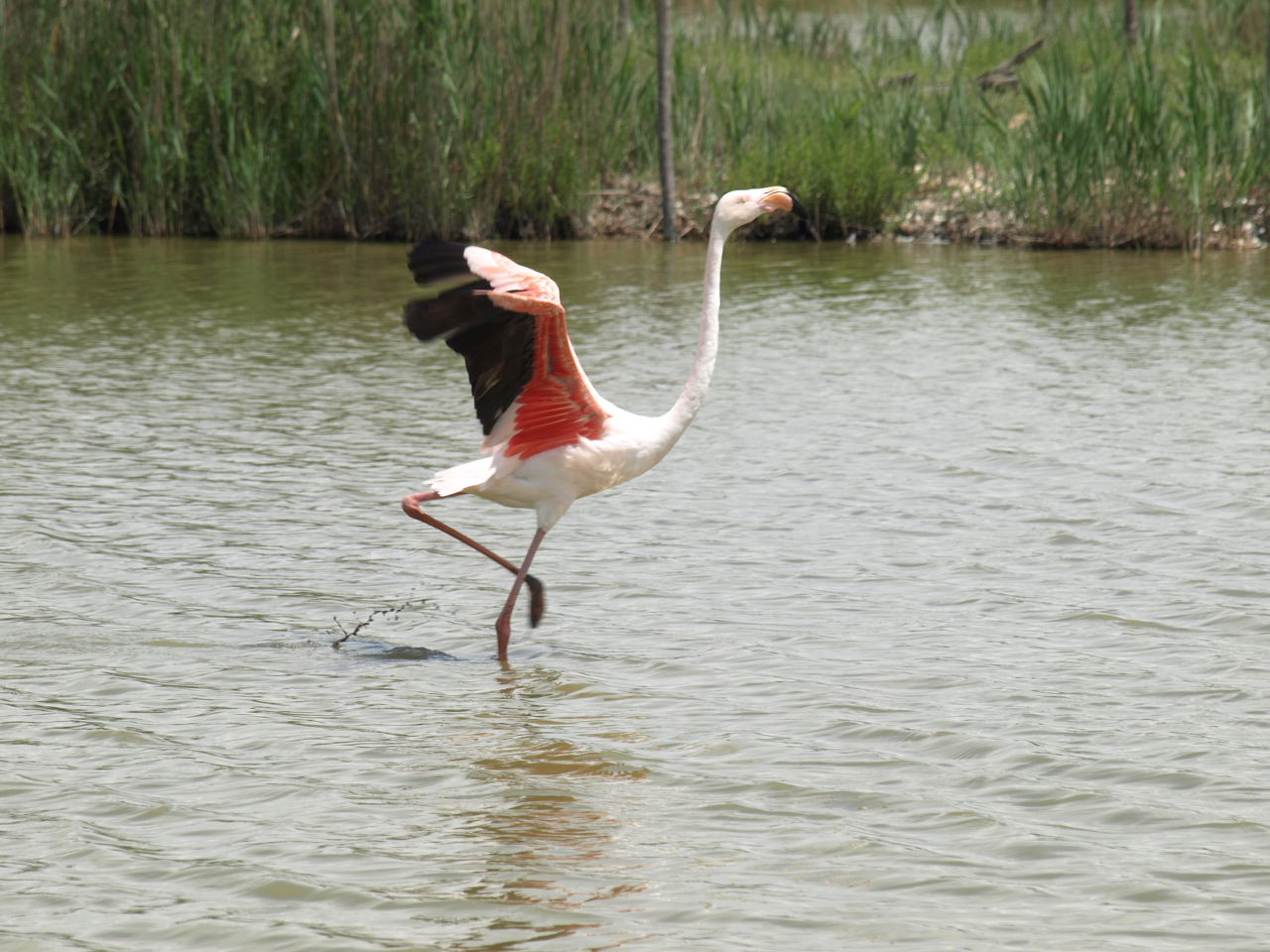
Lake full of flamingoesMore flamingoes. Very bendy necks!Bit of a flap
More pictures – so many to choose from!
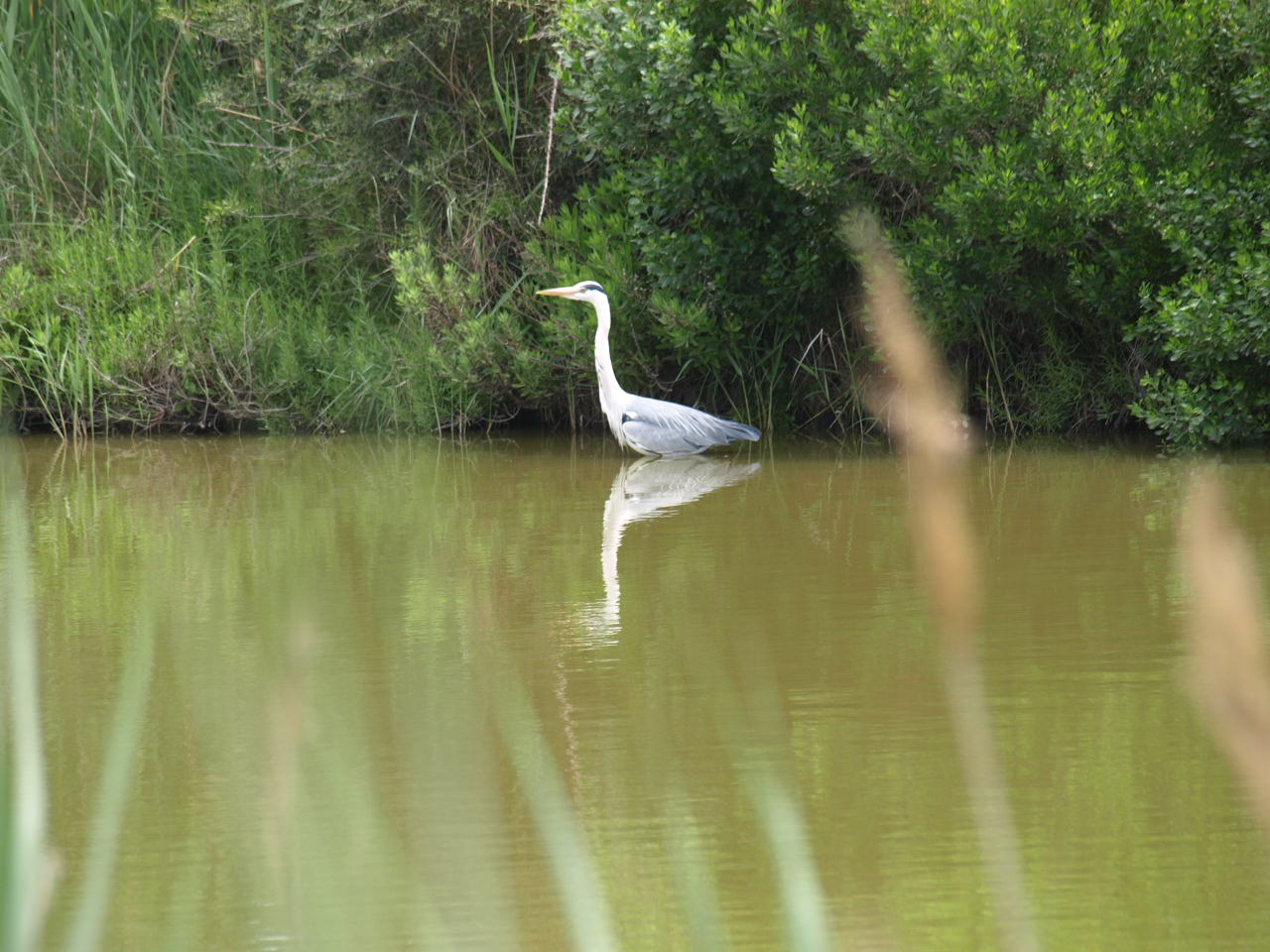
HeronHeronNesting heronsReflective heronRoosting!Handsome chapTaking a strollLovely dark salmon under wingsTwo flamingoes in flightChange of bird
We also explored the environment around the Camargue National Park and there were yet more flamingos and wild ponies. There were a lot more ponies to be observed at the many horseback touring stables throughout the area. I was a bit tempted but decided against taking to the saddle after a break of over 40 years!
Open space of the wild CamargueWild ponies grazing freely
We spent a few days at Saint Maries de la Mer which is on the coast of the Camargue. The site was in a great position with the beach on one side and the National Parc, complete with flamingos, on the other. It was a 30 minute stroll into the rather quaint seaside town with the church dominating the town and visible from miles around.
Church of Saint MarieInside the churchMuseum in the centreSmall square in St Maries de la Mer
After a longer spell in the UK than anticipated, we were off on our travels once more. We caught the 1730 ferry from Newhaven to Dieppe and arrived at 2230 in the dark. As we were familiar with the aires in Dieppe, we were expecting a short drive to our overnight stop. No such luck – both aires were full! After a quick troubled assessment of the situation, we noticed a few motorhomes parked alongside the seaside aire. They were in bays marked bus and coach and so, in the absence of any better plan, we decided to join them. After a peaceful night we awoke to find there were other latecomers parked along the front. By 0900 we had all moved on and I am sure the good citizens of Dieppe would have been none the wiser.
Ferte-St-Aubin
With our usual attention to planning, we had a rough idea that we would work our way down the Loire valley enjoying the scenery and weather. Unfortunately, the weather expectation was a bit optimistic, but we proceeded to a place called Ferte-St-Aubin which is just south of Orleans. We arrived in gorgeous sunshine and stayed on a small campsite a short stroll from the Chateau de la Ferte St Aubin. The chateau was late 16th century and typical of its time. It has been inhabited by the same family for 350 years and the family have opened it to visitors to help pay for essential repairs which are obviously badly needed. It is a charming chateau with a moat and grounds.
Chateau Ferte St AubinAcross the moat to the family chapel
There are 15 furnished rooms to be explored including the kitchens where demonstrations take place on Sundays and holidays. We were there on a Friday so, we missed out.
Chateau kitchen
We were fascinated by the gruesome use of animal trophies as hooks and wall light fittings, particularly complete legs and hooves! The display of childrens toys was fascinating as they really brought the early 20th century to life. We did not explore the parklands adjacent to the chateau as it had started to rain heavily.
Autun
Due to the continuing poor weather, we decided to head a lot further south and return to the Loire valley on our way home. A convenient stopping place was Autun which had an aire near a lake. On arrival, in the rain, we discovered the aire was closed as there had been a triathlon and they were still in the process of clearing up. I consulted the aire book again and discovered that there was another aire by the cemetery. We found said aire which had no amenities, but was very peaceful, and settled down for the evening. There was a splendid view of the lake from the more elevated position. Still raining next day so we did not stop and pressed on south.
St Victor Sur Loire
The aire book had highlighted the next stop and, as it was about the right distance for a day’s driving, we decided to pay it a visit. This was a beautiful free aire overlooking a leisure lake on the Lac de Grangent, fed by the Loire. There were plenty of youngsters enjoying themselves in small boats which was a pleasure to watch.
Sailing activity on the lake at St Victor Sur LoireView from above the aire
We had a walk up to the viewing point behind and above the aire. Although the medieval town would have been nice to visit, we could not walk there so, we decided to give it a miss as we really wanted to press on to Orange.
Luck was with us as we arrived at Orange and the sun shone. We decided to stay on a small campsite that was within walking distance of the town. The owners were very welcoming to this very French campsite with unisex facilities, no loo paper and overgrown pitches. I am not criticising as it adds to the feeling that you are in a different country. We were able to order bread and croissants for the morning which is always a nice option.
The campsite owner provided us with a town map and directed us towards the Arc de Triomphe, which is the nicest entry to the town.
Arc de Triomphe
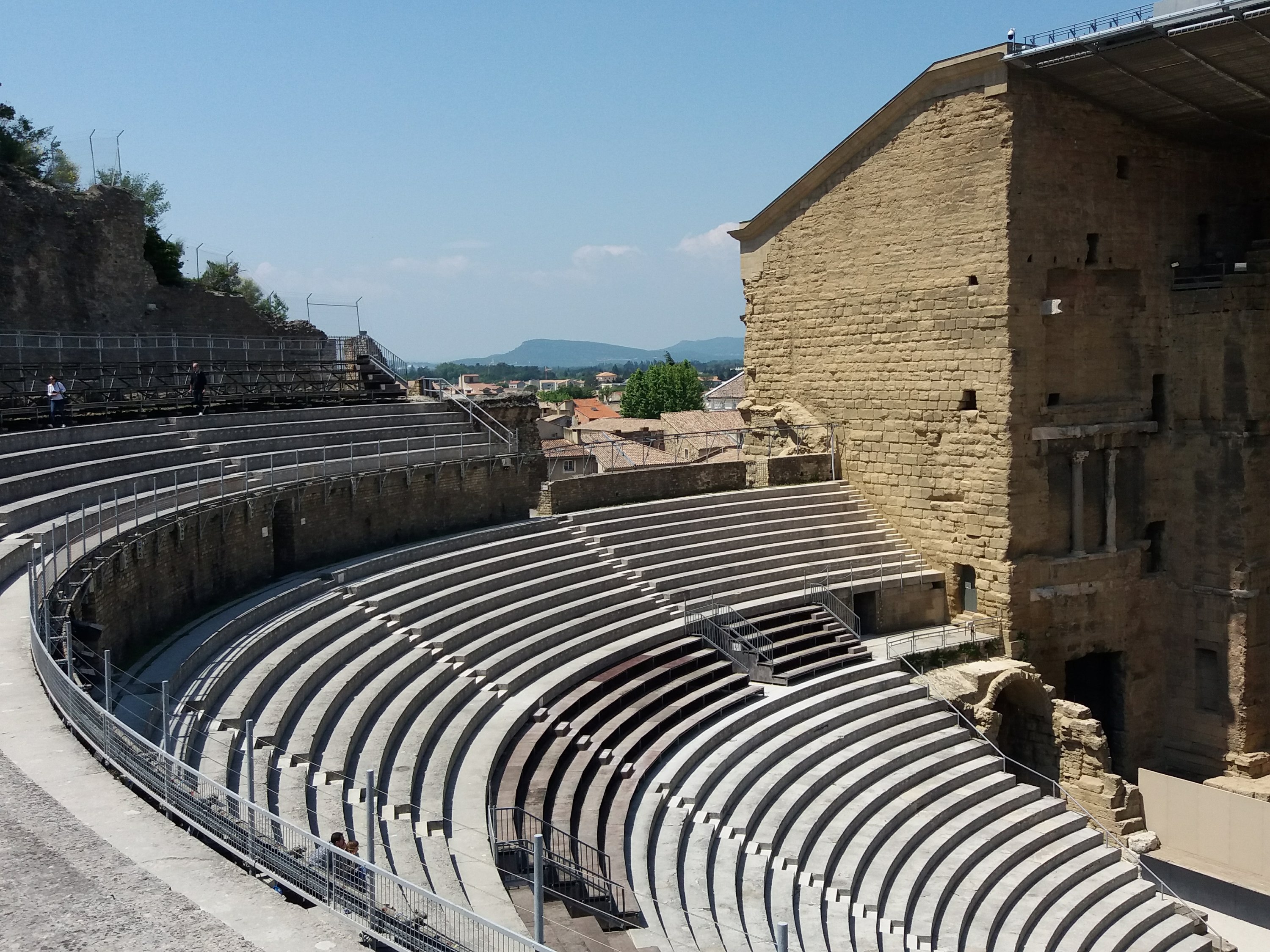
Our main aim was to visit the Roman Theatre and we were not disappointed. It was €32 for the two of us which included a guided tour and a virtual tour. We were able to wander at will with an audio guide and really soak up the atmosphere. We ate our sandwiches sitting near the top of the seating and enjoyed listening to a teacher demonstrating the acoustics to her class.
Looking down across the seatingWall at back of the stage
The Romans really knew how to do things properly. They kept the different classes suitably separated, provided changing facilities for the actors, water in a pond before the stage to float actors and props, and more water in funnels to improve the acoustics. This theatre could seat 9000 citizens which is rather awesome. The virtual tour involved sitting in a room with 3D goggles on and being transported back to the time when the theatre was built and used. It showed how the roof over the stage would have looked and how the tented roof over the auditorium would have been operated. An interesting fact is that the 9 metre statue of the Emperor behind the stage would have had a removeable head. When a new Emperor took over, they simply carved a new head rather than having to produce a whole new statue!
Beside the theatre is the remains of a temple and hemicycle where Romans worshipped their Emperor. This formed an Augusteum, an architectural form dedicated to the Imperial Cult.
Temple remains
After our day at the Roman Theatre we enjoyed a beer in the theatre square and feasted our eyes on the imposing façade. The wall was 103 metres long and 37 metres high. A quick visit to the museum completed our day. It was a bit disappointing after the glorious theatre but came in the price of the ticket, so we persevered.
The town itself is very pleasant to amble around. There are the usual narrow streets with squares and shops and eateries. There were also other attractions which we decided not to visit on this occasion.
One of many lovely squares
The Arc de Triomphe is a 1st Century Triumphal Arch. It is situated on the route of Agrippa and dedicated to the glory of the veterans who founded the Roman Colony of Orange. The depiction of captive Gauls symbolises Roman domination. Work has clearly been carried out to ensure that the arch remains as impressive as it would have been when built.
Detail on the Arc de TriompheArc de Triomphe in all its glory
Avignon
Our next stop was Avignon where we were looking forward to seeing the famous bridge, and the Palais des Papes. We spent 4 nights on a campsite right by the river which enabled us to wander out and take pictures of the changing scene during the daytime and the evening.
Early evening view across the Rhone to the Palais des PapesLit up at nightThe famous bridge
Again, it was an easy stroll into the town. We started our exploration with a visit to the Palais des Papes.
Approaching the PalaisImposing front view
A combined ticket gave us entry to the palace and the bridge. The clever use of technology here added enormously to the interest, as there is very little left in the palace to give an idea of the grandeur. Each visitor is provided with an IPad which is activated by entry into the rooms on the tour. For extra information there are points with circular pads that you hover the IPad over. This activates a visual image of how the room would have looked and you can turn around to get a panoramic view. Very impressive! The palace is huge and you only get to see a relatively small part.
Courtyard
Photos of anything decorative, such as the colourful frescoes, are not allowed so it was only possible to take a limited selection.
Entrance doorway
9 Popes succeeded one another here before the Roman centre became exclusive. The Papal Palace was both a powerful fortress and a magnificent palace and was the seat of the Christian world in the 14th century. Today it is recognized as a UNECSO World Heritage monument. It was a seriously hot day so we did not visit the bridge but went home to the van. The evening sun shining on the Palais was probably our favourite part!
Next day, not quite so hot, we went to the town to enjoy the covered market and the Saturday atmosphere. Again, there are lovely narrow streets of shops and pretty squares where you can sit and watch the world go by, or enjoy a meal. We saw a dear old gentleman playing the hurdy gurdy with his cat contentedly laying by his side.
Man and cat entertaining
We wandered around the market where we bought a delicious cake for our lunch.
Covered market
We then sat under a tree in a square where a jazz trio were playing to the numerous diners.
Jazz at lunchtime
On the way “home” we went to the legendary bridge. The history of the bridge starts with the legend of Saint Benezet, who was canonised for the miracle he performed in laying the first stone of the bridge. Construction of the bridge got properly underway in the mid 13th century and it was only wide enough for single lane traffic. It is therefore, unlikely that there was any dancing!! The bridge was damaged by the impact of climate change at the end of the Middle Ages which affected the hydrological characteristics of the river Rhone. As of the 17th century, the bridge was no longer repaired and so, there is only part of it still standing today. It was still worth a visit as you can walk out into the middle of the Rhone without getting your feet wet.
Looking back along the bridge towards the Palais
We took the free ferry back across the Rhone and enjoyed the stroll back “home” along the busy promenade in the sunshine.
We were steadily working our way to Provence and closing the gap on our friends Carol and Jack. They had found a lovely spot at a place called Massane Plage between Istres and Martigues.
Messane PlageView of the bay at Messane Plage
The village was on the side of L’Etang de Berre, a large lake close to the Mediterranean. There was nothing very exciting about the location but with the lovely sunny weather it was very relaxing. We did manage some nice shots of the lake at sundown.
Etang de BerreSunset bay
After a riotous evening with our friends we all decided to visit a small village a short bus ride away. Next day, we gathered with our backpacks and bus fares to discover – no bus as it was a public holiday! Quick re-think and Clyde drove us there with Jack navigating. St Mitre les Remparts is a village with a history as it was invaded during the war. There is a memorial to a young girl who was executed for her part in the resistence. We met a lovely French gentleman who wanted to show us his garden and enjoyed coffee in the town square. It was a very pleasant little place in which to while away a couple of hours.
Les Mitres des RempartsThe wash houseGarden proudly displayed
Next day, Carol and Jack departed with a recommendation that we should visit Martigues. This time we were successful and managed to catch the bus. Once again, we paid a euro each for a 40 minute journey.
Martigues
Martigues is a charming small town comprised of 3 villages(districts) separated by water. One side of the town faces the Mediterranean and the other overlooks the Etang de Berre. It is known as the Venice of Provence. The house fronts in the centre are brightly coloured and the town is crossed by a succession of bridges that span the canals linking lake and sea.
Coloured houses alongside canal
The town has long been favoured by artists for the colours, light and water. The Place Mirabeau is a group of superb houses built for the bourgeoisie with its own fountain.
Homes for the BourgeoisieMore posh gaffs!
There is a free ferry to take you across the short stretches of water which we enjoyed, if only for the turbulent ride as it crossed the wake of an outgoing vessel!
View from free ferryOld and new
There is still a fishing trade here and there is a bronze statue by the marina showing a fisherman and his wife from days gone by. We saw the genuine article en route to the Tourist Information office. It was late morning and a fisherman was busy winding up his nets on the quayside.
Bronze statue of fisherfolk
The church in the L’Ile district was worth a visit for the lovely organ and colourful interior.
Fabulous organ in St Madeleine ChurchLa Madeleine Church in the L’Ile District
We had a very enjoyable day there and treated ourselves to a light lunch at a pavement café whilst we watched the world go by.
Arles
Apparently, we had not seen enough Roman remains, so Arles was the next must see destination. According to the Rough Guide to France, Arles ranks high among southern France’s loveliest cities. It was originally a Celtic settlement and later became the Roman capital of Gaul, Britain and Spain. The city has a lovely small town feel to it and all the main Roman sites are central to the modern city. On our first day we went in by bus from the village where we were staying. The following day we returned but there was a massive market all along the Boulevard Georges Clemenceau, where the bus terminates, and we ended up on the other side of the Rhone. We should have alighted at the stop before the terminus – obviously, we would know that! It was not a problem as we just stayed on the bus until it made the return trip and jumped off with the locals.
We were given a tourist map when we booked into the campsite and it enabled us to decide what we wanted to see. There is a combined ticked available from the tourist office so, for €12 each we could visit 4 monuments and 2 museums. Pretty good value compared with Orange. We had been given some advice by the Dutch couple on the pitch behind us and decided not to pay an extra €9 each to enter the Van Gogh museum as there are only a few of his works and a much larger Paul Nash exhibition. It would have been interesting but starts to get a bit costly. Anyway, I digress.
Opposite the tourist information office there is a lovely shady park which takes you through to the Roman theatre and then it is a short walk to the amphitheatre. It was a pleasant place to enjoy our sandwiches later.
Our first port of call was the Roman Amphitheatre, known as Les Arenes. It is enormous, 136m by 107m, and would have held 21000 spectators. There are still two tiers of 60 arches standing and you can climb steps up to the tower for a spectacular view over the city and the amphitheatre itself.
Looking down from the cheap seats. Children below learning t be gladiators
When we visited, there was a school party being taught the finer points of being a gladiator which added an element of interest to the place. It also gave an idea of the scale of the place.
View from the streetMore street view
I was particularly struck by the way the streets around it are built in a fan shape radiating outwards. It was particularly visible from the top. There is also a view towards the mighty Rhone. In the Middle Ages, the arena became a fortress, sheltering over 200 dwellings. That gives an indication of its size.
View down from the amphitheatreModern life amongst historyTop of the amphitheatre looking down on the archesArches from belowRear passageway
We also visited the Roman Theatre which is not as impressive as that in Orange. However, it was still of interest and there were a few bits worthy of viewing. Like the theatre in Orange and the amphitheatre in Arles, the Roman Theatre here is used for occasional performances and there is a lovely modern light gantry over the two remaining columns.
Roman Theatre stageStage with modern touch!
The Cloisters of St Trophime were included on our ticket so we paid a visit. The actual cloisters were interesting with corridors from the 12th and 14th centuries but there was an exhibition of modern art which was not so special. St Trophime’s church was a gloomy place which did not excite us much.
St TrophimeSt Trophime CloistersSt Trophime courtyard
We enjoyed a wander around the busy streets of the old town to complete our day and had an ice cream in an ice cream parlour. Clyde’s was enormous because my command of French let me down! I didn’t need to bother really as the helpful chap serving us spoke perfect English. However, I do think it is courteous to speak a bit of the local language where possible.
Next day we returned to finish what we had started. We caught the bus again but as it was Saturday, it did not go to the stop on Boulevard Georges Clemenceau as it was full of market stalls. We found ourselves heading across the Rhone to the residential area! After a tour around the region on the bus, we finally returned to the old town and alighted with the locals. Phew!
The market was enormous and stretched right along the boulevard. We enjoyed looking at a wide variety of goods and local foods and treated ourselves to a pastry and some lemons. As we were going to be in town for a while in the heat, we did not want to buy anything perishable. We also find we are lugging our cameras, sandwiches, water etc…..We really enjoyed the atmosphere and soaked it up before heading to our destination for the day.
Our destination for today was the Musee Reattu which is a contemporary art museum on the banks of the Rhone. It is housed in an interesting old building and there was some interesting art work and photographic studies but, not as impressive as we had expected. The views out over the Rhone were splendid.
Our next destination was to be the Archaeological Museum of Arles. By this time it had become seriously hot and the museum was a very long walk to the other side of Arles so, we decided to save it for another visit and to take a look at the Roman thermal baths instead. They were interesting in as much as the Roman culture of maintaining class distinction was set aside here. The citizens would enter the baths naked and therefore class was not so obvious. The really wealthy folk had their own bathing facilities at their out of town villas of course. There is enough left to give an idea of the scale of the baths and to see how the underground heating system worked.
Archway over bathsExterior wall still standing
It was now mid afternoon and we returned to the appropriate boulevard to catch the bus home. We were surprised at how quickly the market had disappeared. The cars were all parked as usual, buses were coming and going and there was no sign there had ever been a market.
Whilst staying near Exeter we spent a couple of days outside the city. One of the days we devoted to visiting Exmouth, Topsham and National Trust property La Ronde. It was a disappointingly gloomy day but we could see that the seafront at Exmouth would be justifiably popular for families in the fine weather. It has a lovely sandy beach and the train runs along the front to deliver its passengers right to the beach.
Exmouth beach
Exmouth harbourside
We bought delicious pasties for our lunch from a small local bakery. Delicious!
Next stop Topsham. Another attractive harbour. You can undertake a river tour up the exe from here in the season. The town was also very quaint with individual shops.
View from quaysideMisty river view
On the way back to the campsite we visited A La Ronde. This is a 16 sided building that was built in 1796 by cousins Jane and Mary Parminter. They had been on a Grand Tour of Europe in 1784 and built ALaRonde on their return, filling it with treasures from their travels. Mary financed the build and in her very detailed will, she named her successors as solely female relatives. The condition of their inheritance was that they remained unmarried and lived at A La Ronde.
The house has 16 sides in order to make the most of the natural light. The rooms would have been smaller than they are today and there are some interesting shaped spaces which have been put to good use.
A La Ronde
There are commanding views of the sea from here but it was too dull when we visited to take any reasonable photos.
After spending Easter with the family and doing a spot of grandparent duty enjoying the grandchildren, we felt the need for a change of scene. We are a bit stuck in UK for now but making the most of the opportunities to explore. We had never been to Exeter so we booked a few nights at the racecourse campsite.
Exeter Racecourse campsiteView across the heathland beyond the racecourse
On our first day we went in search of the park and ride into Exeter. The nearest park and ride allows campervans but was very full. However, we finally managed to obtain a space and headed into town for the afternoon.
As luck would have it, we were just in time for a free tour of the cathedral. It is a stunning building with so much history. It was started in 1114 and was remodelled in the Decorated Gothic style between 1270 and 1350. The vaulted ceiling is particularly impressive and it is the longest unsupported vaulted ceiling in the world.
Longest vaulted ceiling in the world
There are more than 400 bosses which act as locking stones for the vaulting.
Bosses on vaulted ceiling
There is an astronomical clock dating from 1484 which is still operational, and there is a hole in the bottom of the door below the clock which was cut sometime between 1598 and 1621 to provide access for the Bishops cat to deter rats and mice!
Astronomical clock
The organ is unusually placed in the centre between the nave and the choir. There are further organ pipes along the West wall that provide the lowest notes. The longest pipe is 36 ft tall.
There was so much of interest inside the cathedral but it is equally attractive on the outside and it can be seen from the modern shopping centre with a particularly fine view from Debenhams cafe.
Cathedral frontCathedral Yard viewSeen from shopping centre
Next day we were earlier to town as we wanted to join a tour of the city. There are a number of tours offered free by the Exeter Red Coat guides. We spent 2 hours with our guide and gained a much better picture of the development of the city. One of the oldest parks is Rougemont Gardens which are on the site of the castle, following the city wall.
Rougemont Gardens Introduction boardCastle built into city wallGarden view
There was so much more information provided by the guide but too much for here.
Decorated wall in the back streetsOriginal entrance to the city
The last place on the tour was the Guildhall. It is the oldest civic building in constant use in Europe. The ceiling in the council chamber is very ornate.
Ceiling in council chamber
After the tour we went down to the quays for a wander. There are some little individual craft shops which needed my attention. I spent some money there and we also had coffee overlooking the river. Quite a pleasant spot even on a rather dull day.
Exeter Quays
Altogether an interesting city. There are a lot more places to visit in Exeter but they will have to wait until next time.
On our way between Gosport and Bedford we needed an overnight stop. We took a chance and parked in a seafront car park near Titchfield Haven. It was completely deserted except for the odd dog walker and lots of birds. In the morning we enjoyed a walk along the beach as the sun rose. Rather lovely.
Early morning view from car parkHarbour at Titchfield HavenEarly morning gathering